Morningstar DesignWorks, LLC · Release 1.0
Browser tool · 3D · Print-ready
Phyllotaxis Head Lab
Grow a seed head one seed at a time and watch the spirals appear, in seeds, petals, scales or leaves. Each seed turns 137.508° from the last, and two families of arms, counted in Fibonacci numbers, fall out of that one rule. Trace an arm, then a second one turning the other way, and find the seed where they cross. When you like what you've grown, send it straight to your slicer in color, or to CAD, with a flat, fully packed base ready for the print bed.
$14.99Instant download · one HTML file, an illustrated handbook and a README
Try it · free
Grow one right now
No download, no sign-up. This is the real lab with some of it held back: grow a head, count the arms, trace two of them and watch where they cross.
You are watching a preview. Click the lab to take over.
The demo gives you the dome and the flat disc, sphere seeds and up to 200 of them. The full lab adds:
- Ten seed shapes
- Six head shapes
- 2,000 seeds
- Color 3MF for your slicer
- STEP for CAD
- GLB for the web
- The offline file, yours to keep
What you can do
Grow it, count it, trace it, look inside
Everything is live. Move a slider and the head rebuilds in place, so you can see exactly what each number does.
Rise from the base
The oldest seeds sit on the rim at the base plane, so the head climbs upward in Z as it fills in. The receptacle surface rises with it. Scrub growth by hand or let it run.
See the Fibonacci arms
Overlay any pair of arm families, from 3/5 to 55/89, or type your own. Fibonacci pairs make clean spirals turning opposite ways. Anything else stops reading as arms.
Follow the path
A marker walks one arm seed by seed, lighting each one. Hold it, trace a counter-rotating arm, and the seed on both paths turns red. You can also follow the genetic spiral in birth order.
See it from below
Orbit all the way under the head, or jump to the view from underneath. Add an inner skin and the seeds sit half buried in it, like a pineapple's eyes. Set how deep they sink.
Six heads, ten seeds
The same rule on any shape
Seeds are spread by surface area along each shape's outline, so the packing stays even across curves, corners and overhangs.
Dome
A half ellipsoid, like a sunflower or daisy head.
Cone
Straight sides rising to a point.
Column
A true cylinder. Seeds run across the flat top, then down the wall.
Pineapple
A convex egg shape, widest just below the middle.
Spindle
Narrow base, swells, then narrows toward the top.
Flat disc
The sunflower face, lying on the base plane.
Ten seed shapes
Swap the spheres for petals, bracts, scales, kernels or leaves. Botanical shapes grow from the center to the rim, and an Opening control takes a rose from tight bud to full bloom.
How it works
One angle, two families, one crossing
The lab uses Vogel's model. Seed k is turned k × 137.508° and placed at the fraction (k + 0.5) / N of the head's area, measured from the apex. On a flat disc that is the familiar r = R√(k/N).
That angle is not chosen, it is forced. Cut a circle so the long arc is to the short one as the whole circle is to the long arc, and the short arc is 360° ÷ φ² = 137.50776°. Because φ is the hardest number to approximate with a fraction, no seed ever lands on top of an earlier one, at any count. The handbook works the arithmetic through.
An arm of family A links seed n to seed n + A. For a Fibonacci pair, A steps drift slightly one way and B steps slightly the other, so the families wind in opposite directions.
Two arms share a seed only when its number fits both at once. For 13 and 21 that happens once every 13 × 21 = 273 seeds, which is why a 400-seed head shows one or two red seeds, and why they move when you pick different arms.
B: n → n + 21 clockwise Crossing n ≡ a (mod 13) and n ≡ b (mod 21)
one seed in every 273
Built for 3D printing
From the lab to the print bed in minutes
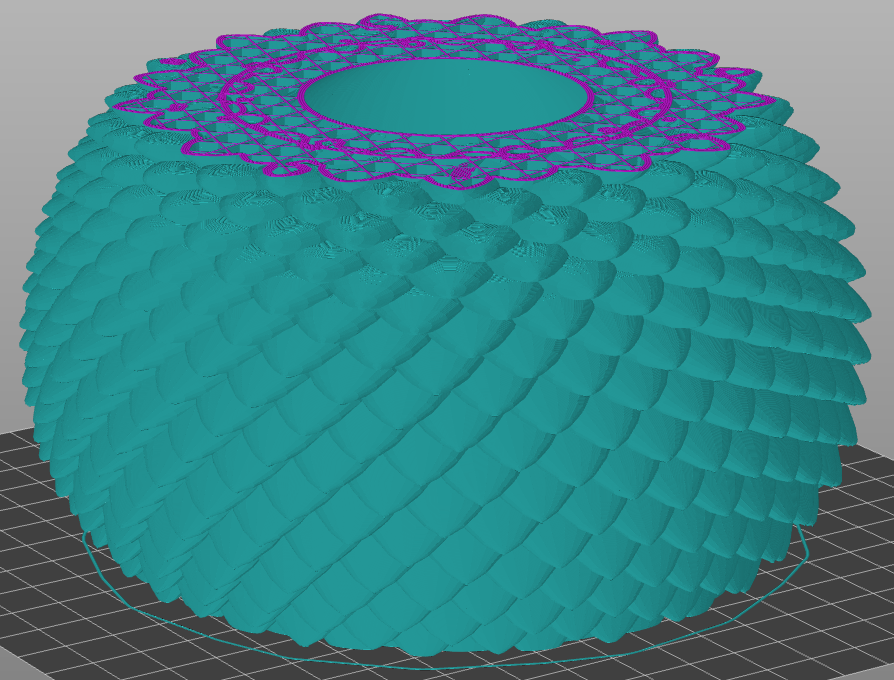
The head grows from below the base and is cut flat at it, so every piece sits square on the bed with a full row of seeds right down to the first layer. Export a color 3MF straight to your slicer, or a STEP, in color, to CAD when you want to shape it further.
- Grow itPick a shape, set the size in inches, and dial in the seeds and skin depth. The readout shows the finished size and volume in cubic inches.
- Export 3MFOne click. Every color you see becomes its own part, watertight and ready to slice. No CAD needed.
- Assign filamentsGive each part a filament in your slicer. Two-color spiral arms come out exactly as they look in the lab.
- PrintThe flat base goes straight on the bed. Want a perforated shade instead? Export STEP and cut the seeds out in Fusion.
- Multi-color ready. Choose every color with HSL sliders; the 3MF keeps them as separate parts, made for AMS, MMU and other multi-material printers.
- A GLB for the web, so you can show what you made on a page, spin it, or stand it on a desk in AR.
- Flat, fully packed base. No ragged bottom row, no gaps where the pattern runs out.
- True size in inches, with an export scale for anything from a pendant to a floor lamp.
- Material at a glance. The seed and skin volumes help you estimate filament or resin before you slice.
- Less overhang when you want it. Raise the skin depth to bury more of each seed.
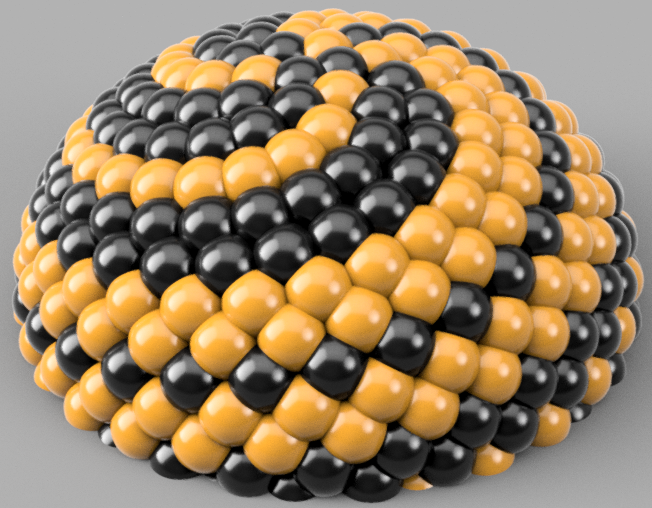
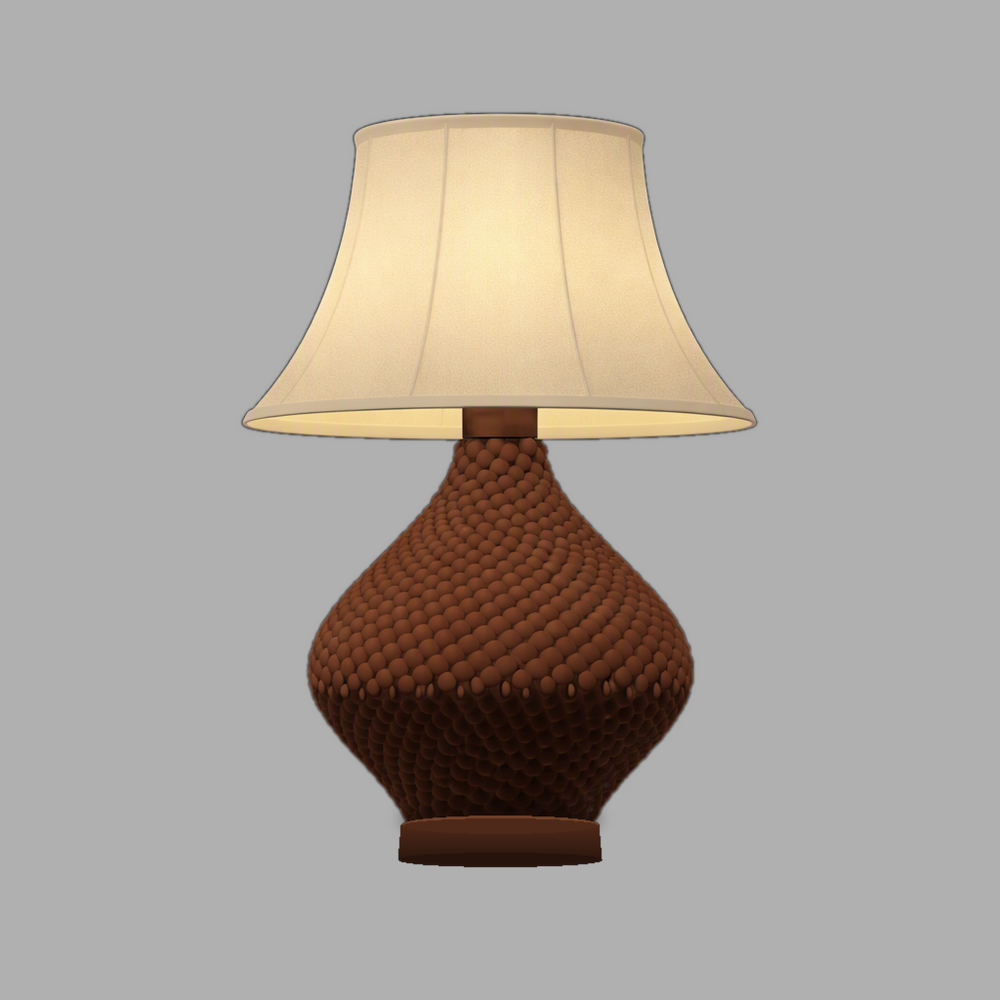
Seeds plus skin: a beaded, pineapple-textured vase, planter or sculpture.
Seeds out of the skin: every seed opens a hole. A perforated lamp shade in one step.
Hollow the skin into a bowl or a cover for an LED puck light.
Alternate arms, a traced spiral or a red crossing, each printed in its own filament.
Made for makers
Who it's for
Anyone who turns geometry into objects. Phyllotaxis gives an organic, even pattern that reads as natural at any size.
3D printing
Vases, planters, desk sculpture, printed roses and succulents, and gifts with a pattern nobody else has.
Lighting
Perforated shades and diffusers that throw a spiral of light across the room.
Woodturning and CNC
Every shape is a turned form. Carve the seed pattern on a 4-axis router or use it as a guide on the lathe.
Ceramics and pottery
Print texture stamps, press molds and slip-casting masters with the pattern built in.
Casting and molds
Masters for silicone molds: resin, concrete planters, candles, soap and chocolate.
Jewelry
Scale down for pendants and earrings, then print in castable resin for lost-wax casting.
Teaching
Show the Fibonacci numbers and the golden angle, then hand students a printed model to count.
Sculpture and design
Parametric studies for facades, installations and furniture, straight into CAD.
Controls
What each setting does
| Setting | Range | What it does |
|---|---|---|
| Head | ||
| Shape | 6 shapes | Dome, cone, column, pineapple, spindle or flat disc. |
| Radius | 1 – 10 in | The widest radius of the head. |
| Height in Z | 0 – 20 in | How tall the head stands above the base plane. |
| Widest point, base width, top width | shares | Shape the pineapple and spindle profiles. |
| Inner skin | 5 – 100% | A solid skin behind the seeds, reaching into them by a share of their diameter. Half buried by default. |
| Views | top, angled, side, below | Orbit all the way around, or look up from underneath to see inside the head. |
| Seeds | ||
| Seed shape | 10 shapes | Sphere, bead, spike, pin, hex cell, pine cone scale, corn kernel, rose petal, artichoke bract or succulent leaf. |
| Size change | 0 – 100% | Seeds grow from the young center to the old rim. |
| Opening | 0 – 100% | Petals, bracts and leaves, from closed bud to open bloom. |
| Number of seeds | 21 – 2000 | Drag the slider or type an exact count. More seeds bring out larger Fibonacci pairs. |
| Seed size | 0.02 – 0.80 in | Base size of every seed, or fitted to the head automatically. |
| Divergence angle | 120° – 160° | Golden angle by default, with shortcuts to near misses and rational angles. |
| Seed pattern | 3 modes | One color, or alternating along the family A or B arms so the spirals show without lines. |
| Colors | HSL, 8 parts | Set hue, saturation and lightness for the seeds, arms, crossings and skin, with a line saying what each part colors. Four presets included. |
| Arms and growth | ||
| Fibonacci pair | 3/5 – 55/89 | Which two families to draw, or any custom pair up to 200. |
| Seeds per second | 5 – 600 | Growth speed. Scrub the seeds-grown slider to step by hand. |
| Tracing | ||
| First trace | A, B or genetic | Follow one arm, or every seed in birth order. |
| Second trace | other family | Holds the first trace and follows a counter-rotating arm. Crossings turn red. |
| Trace speed | 0.5 – 60 | Seeds per second, shared by both traces. |
| Export | ||
| 3MF file | 3 detail levels | Watertight color parts for your slicer, sized to match the inch readout. |
| GLB file | 3 detail levels | The same colored parts for the web, AR and Blender, in meters with Y up. |
| STEP file | seeds, skin | A smooth skin solid and exact spheres (other seed shapes flat-sided), cut flat at the base, in color, for any CAD program. |
| Export scale | 1 – 1000% | Resizes the file without changing the pattern. The readout shows size in inches and volume in cubic inches. |
Things to try
Start discovering
- Grow a rose. Low dome, about 110 seeds, rose petals. Slide Opening and watch the bud bloom.
- Press Top, then count. The ochre arms turn one way and the blue arms the other. The counts match the pair you picked.
- Click 137.3° or 137.8°. A fraction of a degree off golden, the spirals straighten into spokes near the rim.
- Click the 8/21 turn. A rational angle puts every 21st seed on the same ray.
- Grow a column. The spirals flow off the flat top and down the wall without a break.
- Try a pineapple with hex cells and 8 / 13. That is the count on a real pineapple.
- Turn on the inner skin and look from below. You're looking up into the head. Slide the skin depth and watch the seeds sink into the rind.
- Pick your filament colors with the HSL sliders, then export a 3MF. Print it in two colors and the spirals are built right into the piece.
- Export a STEP and cut the seeds from the skin. In Fusion, that's a perforated lamp shade in one step, with the bodies already colored and grouped.
- Trace an arm of 13, then an arm of 21. Find the red seed, then change the second arm and watch it move.
Phyllotaxis Head Lab
Grow your first head
Morningstar DesignWorks, LLC