 Image 1 of 1
Machinist's Hammer Detail Bench — Shop license
Configure a soft-face machinist's hammer — or a hand tapper with no handle at all — and get the detail prints out the other side. One HTML file, runs offline in any browser, nothing to install. Licensed to one person, in their own shop: make as many as you like and sell every one of them.
One file. Download it, double-click it, and it runs. No install, no account, no internet, nothing sent anywhere. Keep it wherever you keep documents and back it up the same way. It works offline forever, and the handbook travels inside it.
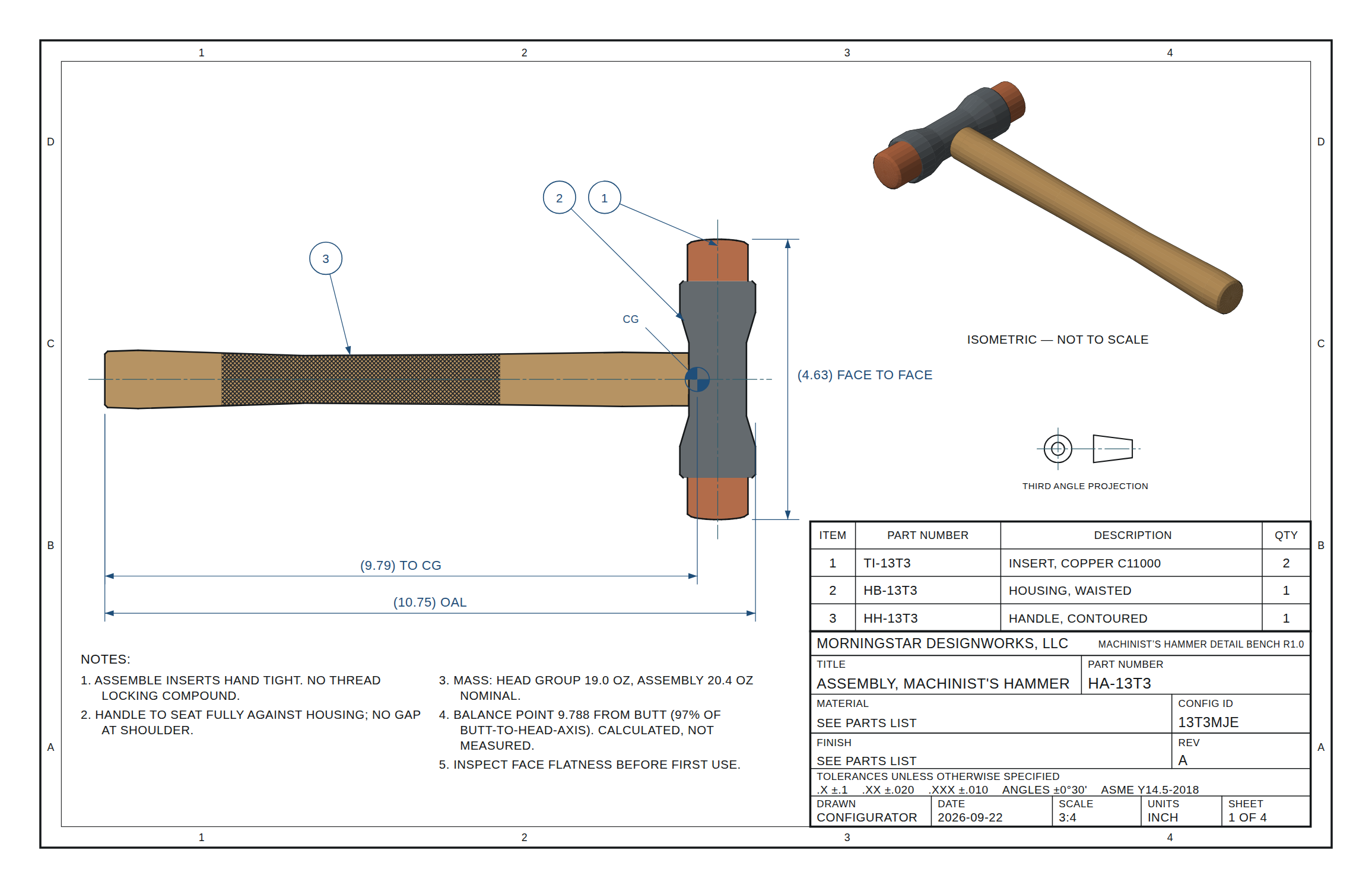
What comes out. ANSI B sheets in third-angle projection with ASME Y14.5 annotation — assembly, handle, housing, tip insert, and the sheets the configuration earns: the brass cap that closes a gun-drilled butt, the monogram, the O-ring on a shot-tube head, the spanner wrench cut to your own insert. Layered R12 DXF, true-size SVG with the engraving on its own layer, and a STEP assembly — real named components, each part in its own material color, threads on their basic envelopes with the designation in the component name.
Why the sheets agree with each other. One profile drives every view, the section, the isometric, the mass, the balance and the STEP export. Every dimension on the paper is the parameter you set, formatted — never a number measured off a picture. Change the barrel diameter and the whole set moves together, because there is only one thing to move.
What you can build. Five housing styles — cylindrical, hex, waisted, square with turned ends, and a shot-tube dead blow. Four grip forms from a plain cylinder to a full-hand fat grip, knurled or not, gun-drilled for light weight or solid. Faces from 3/8 to 1-3/4 in brass, copper, steel, aluminum, acetal, nylon or urethane, flat or crowned, and a different material on each end if you want one. Initials engraved on the housing in four letterforms, with the sheet telling you what will cut them.
It tells you when something will not work. A face that would overhang the bore is not offered. A grip too fat for the housing stops the slider rather than drawing a stepped joint. An engraving that would reach the handle bore is trimmed to the largest size that fits, and it says so. Knurl a housing and ask for a laser-marked monogram and it stops you, because a laser cannot mark a knurled surface.
A drawing is a proposal, not an inspection. The bench is internally consistent, which is most of what goes wrong on a hand-drafted print — but the datum scheme, the tolerance block and the thread class are template decisions, and reviewing the output is yours. Check it before you cut metal.
What this one covers
Licensed to one person. Install it on as many machines as you personally use — it follows you, not a computer.
It does not cover a company. Using the bench on behalf of a business with more than one person in it, or issuing its drawings as a company's controlled or released documentation, is the product license.
What every license grants
Produce unlimited drawings, DXF, SVG and STEP files from the bench, and make and sell the parts you draw — no royalty, no reporting, no cap on quantity. What you make with a tool is yours; that is what tools are for.
Give a drawing to a machine shop, a laser house or a plating house so they can make your part.
Keep using the version you bought for as long as you like. There is no subscription and nothing expires. Every update within Release 1 is free, and a future Release 2 would be a separate purchase — Release 1 is not taken away from you when it arrives.
What no license grants: sharing, reselling, sub-licensing or publishing the bench itself, putting it on a network or a website where others can reach it, or removing the release and authorship markings from the file.
The license, in one line. Yours to keep, and yours to sell the parts you make with it. The one thing it does not allow is passing the file itself on.